

Why RD Studio Families Set a New BIM Standard

Smarter Revit Families Start Here
We’ve all been there. You download a native Revit family online, drop it into your project, and immediately realize the internal logic is completely broken. It’s inflexible, it hasn’t been tested, and the parameters behave like they have a mind of their own.
At RD Studio, we know what it's like to waste billable hours fixing messy families. That's why we don’t just build "content." We build systematically. We operate on strict BIM modeling rules that govern everything—from family and type naming conventions to parameter order, material hierarchies, and internal logic.
Building Revit families without a strict modeling guideline is like designing a massive UI in Figma without a design system. Or like driving on the highway without understanding traffic rules. It’s going to end in a crash.
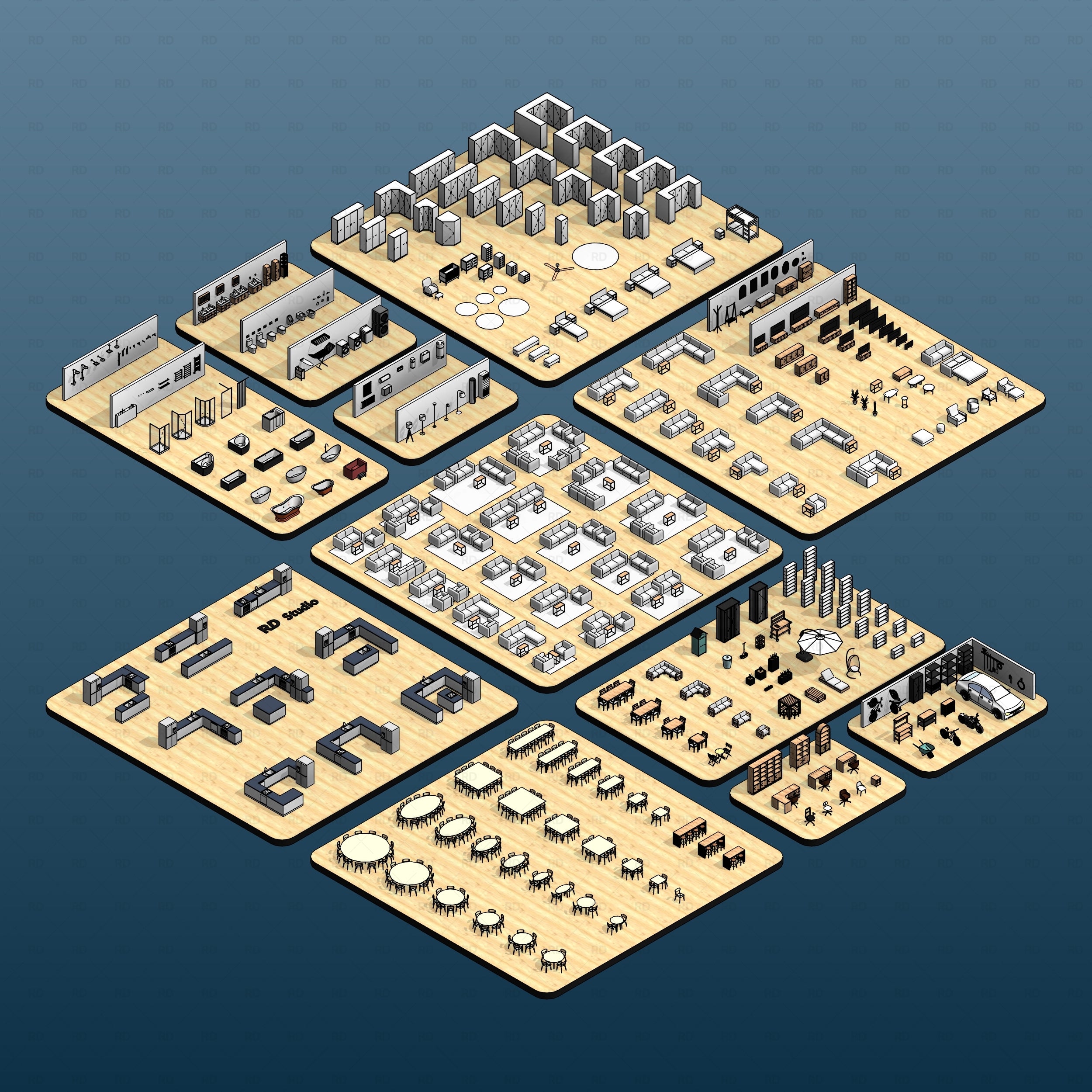
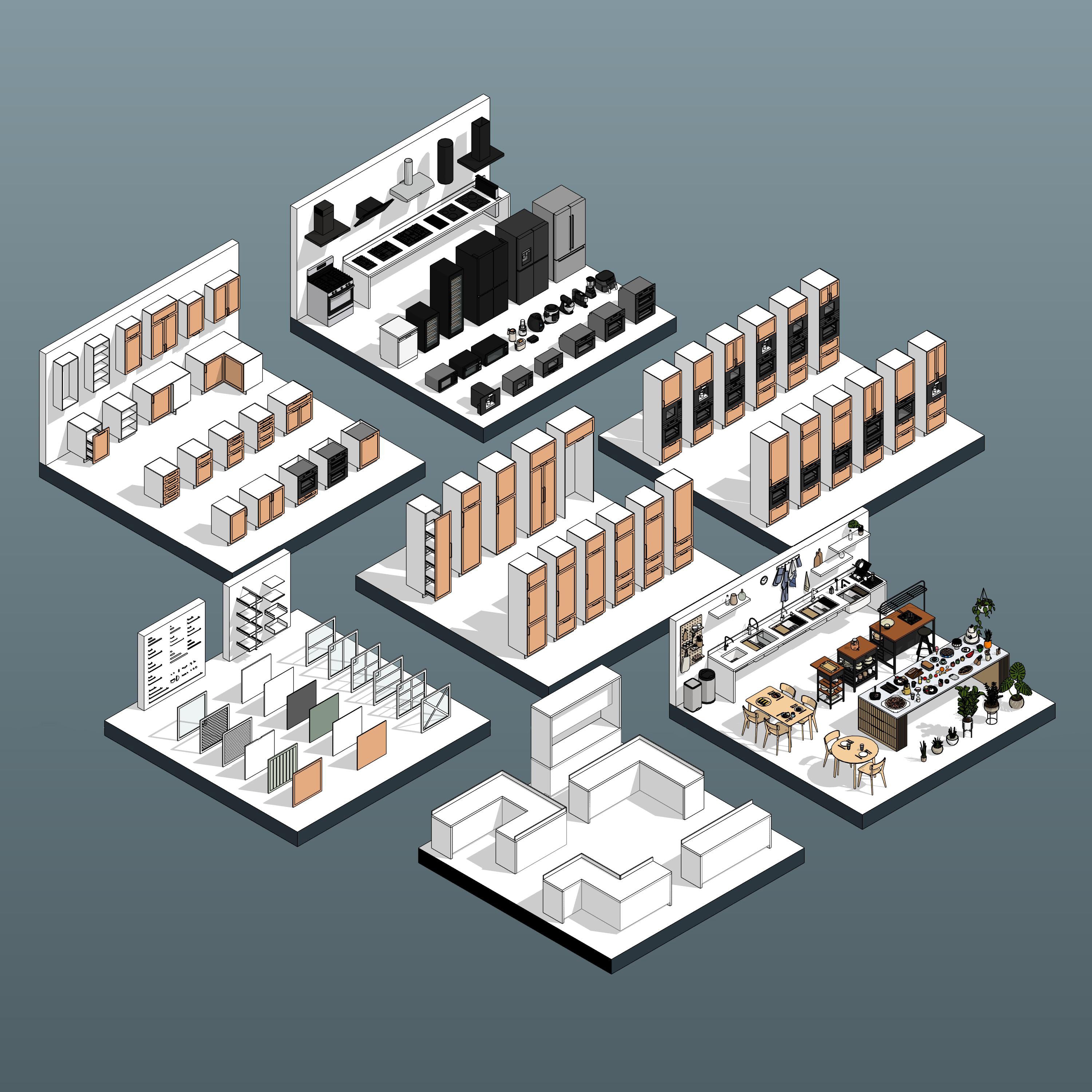
Whether it's our massive residential libraries, highly detailed specialty equipment, scalable landscaping, or complex architectural elements—our goal is simple: eliminate the friction in your workflow.
Trusted by over 80,000 architects, designers, and BIM professionals.

The Business Value: The "Free" Trap and Your ROI
Let’s talk ROI, and let's address the elephant in the room. Why pay for a library when the internet is full of "free" content on sites like BIMobject or RevitCity?
Because free families aren't free. You pay for them with the 45 minutes your architect spends purging nested files, deleting random foreign-language materials, and trying to figure out why a cabinet schedule is entirely blank.
Clean, lightweight, native Revit families are an operational asset. They prevent model crashes, reduce project lag, and give your team their time back to actually design instead of doing software triage.
Industry Standard vs. The RD Studio Standard
We surveyed the landscape, checked our competitors, and realized the industry standard simply isn't good enough. Here is where we draw the line:
- Geometry: Manufacturers often take the lazy route. Because they’ve already invested heavily in software like SolidWorks or Inventor for fabrication, they refuse to remodel natively in Revit. Instead, they export a heavy, un-editable 3D mesh and call it a day. We build 100% lightweight, native Revit geometry.
- Unit Systems: The industry generally doesn't even bother offering both systems. You are usually stuck with either metric or imperial depending on who made it. We deliver both systems in a single pack.
- Quality Control: The industry standard is "export and forget." We rigorously stress-test every single parameter for maximum and minimum values- twice- before a family ever hits our catalog.
The RD Studio Blueprint: How We Build
We solve the daily frustrations of thousands of BIM modelers by delivering professional, thoughtfully structured content. Here is our playbook.
🎯 Users First
We don’t model in a vacuum. Every RD Studio family starts with a user in mind. The modeling approach, geometry, parameters, and detail levels follow that use case precisely. We invest time in defining our customer profiles for each collection:
- Architects - Working typically on medium to large scale projects, focusing on data, schedules, and building assets
- Interior Designers - Focusing on detail and fast changes locally (hint - Instance Parameters)
-
Landscape Architects - Where planting and site Families have to be lightweight but also parametric
• If it's a Type parameter, check whether it makes sense to duplicate the Family Type for it.
• If it's an Instance parameter, ask yourself if that makes sense for your Schedules.


Sometimes, it even makes sense to model the same collection twice! Take a look at our Revit parametric sinks collection with two options:
- Architect Edition - Stripped out of accessories, lightweight
- Interior Designer Edition - Fully equipped with all necessary accessories that the client expect to see in renders
And before you ask, why don't you use Detail Level and show the accessories in Fine? The answer is that it still affects the file size, and in a 12 story building, 4 apartments in each floor, we bet no one cares about the drainboard.

🧠 Brand-Free, Market-Smart Families
Our families aren’t limited by a single brand. We study real manufacturers, market trends, and typical use cases to design smart catalogs based on form, function, and relevance. The result is a flexible family that represents real-world brands—without locking you into one manufacturer early in the design phase.


📏 Metric, Imperial, and Regional Graphic Standards
All of our latest packs include files for both metric and imperial systems, helping you avoid unit conversions. But we don't stop at dimensions. We also account for regional graphic standards. For example, elevation opening lines for doors and cabinetry are drawn differently in Europe versus the US. We've built in options to toggle these graphic standards so your drawings read correctly no matter where your firm is based.


🧼 Dashboards That Don’t Make You Cry
We treat our type and instance parameters like UI design. Everything is grouped, clearly labeled, and intentionally ordered. You won’t find a wall of greyed-out fields or a chaotic list of mystery values.

🎛️ The "All or Nothing" Visibility Trap
Ever tried to turn off just the handles on a cabinet in your 3D view, only to realize the entire object disappears because the creator modeled everything on a single default layer? We rigorously assign subcategories (glass, hardware, clearance) so you can control visibility and line weights in your project without opening the family editor.

🛠️ Flexible Without Breaking
Ever type a new width dimension and get hit with the dreaded "Constraints are not satisfied" error? We test our reference planes and formulas so the geometry actually flexes instead of shattering into a million pieces the second you change a parameter.

📐 Plans That Read Like Drawings
We obsess over symbolic views. Your floor plan won’t be ruined by messy 3D geometry or cluttered fills. We build and test symbolic lines for each family so you can trust what comes out of the plotter.

📦 Lean But Capable
Our goal is to keep families under 1MB without sacrificing power. If a file exceeds that, it’s backed by smart logic for coarse detail modes or visibility controls to reduce the performance load.

🔍 Scalable Detail
From a 1:500 site plan to a 1:10 elevation, you get visuals that match the drawing scale, not just scaled chaos.

📏 Fully Parametric – Built for Real Life
Families include dynamic parts that respond to parameters and user input, so your models reflect how the object actually behaves in space (like opening drawers or showing appliance swing ranges).


🤝 Collaboration-Ready
MEP connectors are built in, always. Our architectural content is ready to plug into real coordination workflows, not isolated from them.

🔎 Base Points and Reference Planes Matter
If you’ve ever placed a family that floated three feet in the air or flipped backward, you know how infuriating bad modeling is. At RD Studio, we plan insertion points, set reference planes properly, and actually name them.
- ✔️ Insertion points always align to expected geometry.
- ✔️ Wall-hung elements snap predictably.
- ✔️ Reference planes are clean, named, and set for snapping.
Most teams skip this because it's tedious. We never do. That’s the difference.


✨ High-End Aesthetics & Interior Detailing
A common myth is that "lightweight" means "ugly." Not here. We build super-detailed families specifically for interior design and visualization. From high-end decor and modern appliances down to the small stuff that brings a rendering to life, our geometry is optimized to look premium in Enscape, V-Ray, and Twinmotion—without causing your Revit model to bloat.

FAQ: Expert Insights on BIM Content
Why are manufacturer-provided Revit families often problematic for large-scale projects?
Manufacturer files are built for fabrication or marketing, not for architectural BIM coordination. They tend to be heavy exports from manufacturing software, bloated with unnecessary product data, and entirely inflexible. Our brand-free approach ensures you get a clean, lightweight, highly parametric family that can represent multiple brands without lagging your model.
How does parameter structuring actually impact Revit schedules and project health?
When families lack a cohesive parameter strategy (like misusing Type vs. Instance parameters or ignoring naming conventions), it corrupts your project data. Poorly structured families lead to fragmented schedules, missing information, and manual data-entry errors that defeat the entire purpose of Building Information Modeling.
What is the true cost of using non-native geometry in Revit?
Non-native meshes cause immediate file bloat and degrade model performance. Beyond the lag, imported geometry rarely dimensions correctly, cannot be easily assigned native Revit materials or subcategories, and usually looks like a chaotic mess of triangulated lines in your 2D plans and sections.
🧰 Where to Start
RD Studio families aren’t just content. They’re a workflow upgrade. Built by professionals, for professionals who are tired of fixing broken downloads. Ready to simplify your modeling life?
👉 Explore our full collection of Professional Revit Families
👉 Browse all 3D Revit Families in one place


Leave a comment